Buyer Guide
How to Choose Induction Melting Furnace Capacity and Power
The sizing mistake that costs foundries the most money is buying the furnace they can afford instead of the one their pouring cycle needs. Here is how to work it out.
ForgeLink Engineering Team9 min read
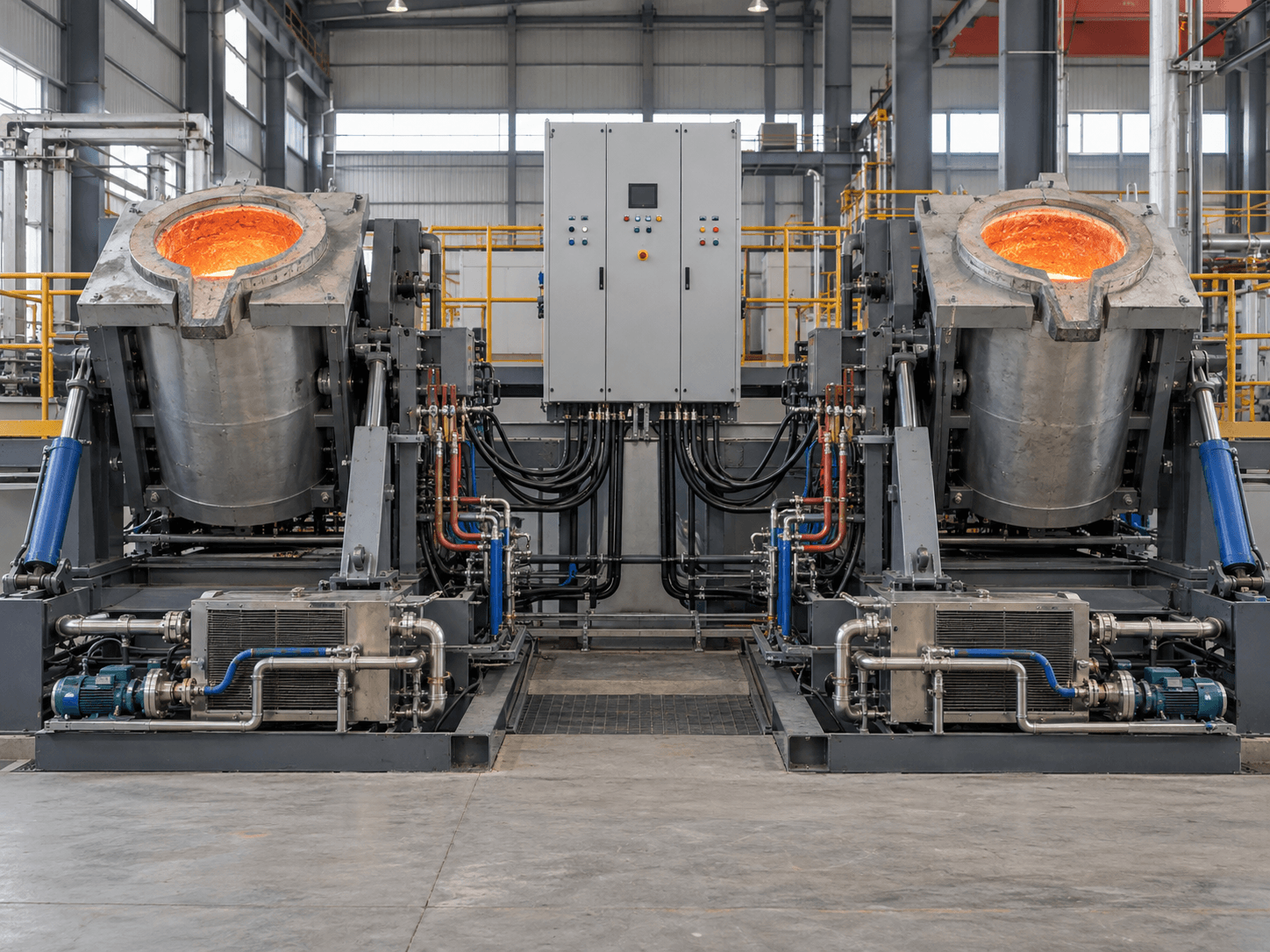
Almost every foundry that regrets a furnace purchase made the same error: they specified the furnace first and worked out the production plan afterwards. Capacity and installed power are not independent numbers you pick from a catalogue — they are consequences of how much metal you pour, how often, and into what.
This guide walks through the sizing method our engineers use, the ratio that tells you whether a quotation makes sense, and the three questions that decide whether you need one furnace or two.
Start with the pouring cycle, not the furnace
Write down the tons of good metal you need per shift, then divide by the number of pours. That gives you the size of one heat. The furnace should hold one heat comfortably — around 80–90% of nominal capacity — not exactly one heat, because you need freeboard for slag and for the heel you carry between heats.
A foundry pouring six heats a shift at 1.6 tons per heat needs a 2-ton furnace, not a 1.5-ton furnace run over-full or a 3-ton furnace run half empty. A half-empty induction furnace is inefficient: the coil couples poorly to a low bath and you pay standing losses on a lining sized for metal that is not there.
Then size the power to the melt time you need
Installed power decides how long a heat takes. The useful check is the kW-per-ton ratio: for melting steel from cold scrap, roughly 700 kW per ton of capacity gives you approximately one heat per hour. Halve the power and the heat takes twice as long, which halves your output from the same furnace.
This is where quotations diverge most, and where the cheapest one is usually cheapest for a reason. A 2-ton furnace offered with 600 kW and a 2-ton furnace offered with 1,000 kW are not the same machine competing on price — they are different production rates. Always compare kW, not tons.
- ≈ 700 kW per ton — approximately one heat per hour on cold steel scrap
- ≈ 500 kW per ton — approximately one heat every 90 minutes
- ≈ 350 kW per ton — approximately one heat every two hours; suitable for holding-heavy operations
- Below 300 kW per ton the furnace becomes a holding vessel with melting as a side effect
One furnace or two?
A single furnace body stops melting during a lining change and its sintering cycle. Depending on the lining and furnace size, that is typically the better part of a shift, and it recurs every time the lining reaches end of life. If you run one or two shifts with a weekend, you can schedule around it. If you run continuously, you cannot.
The dual-track configuration — two furnace bodies sharing one power supply through an interlocked switching cabinet — solves this. You melt on one body while the other is relined, cooled or held on standby. It costs more than a single-body plant of the same capacity, and for a continuous operation the recovered production usually pays that back quickly.
The three questions that change the answer
Before finalising any specification, answer these. Each one can move the recommendation by a whole furnace size.
- Do you hold metal between pours? Holding time consumes power and lining life, and shifts the optimum toward a larger furnace with a lower power ratio.
- How dense is your charge? Light or bulky scrap needs more charging cycles per heat, and charging time becomes the constraint rather than kW.
- Will your output grow? Adding a second furnace body to an existing dual-track power supply is straightforward; upgrading a power supply later is not.
What to send a supplier
A serious supplier will not quote from 'I need a 1-ton furnace'. Send the alloy, the tons per shift, the number of pours, the hours per day, the grid voltage and frequency, and the available floor area and ceiling height. Anyone who quotes without asking for those is quoting a catalogue item and hoping it fits.