Technology
KGPS vs IGBT Induction Power Supply: Which One Should You Buy?
IGBT is newer, but newer is not the same as better for every duty. A practical comparison of thyristor and IGBT medium frequency power supplies for buyers.
ForgeLink Engineering Team8 min read
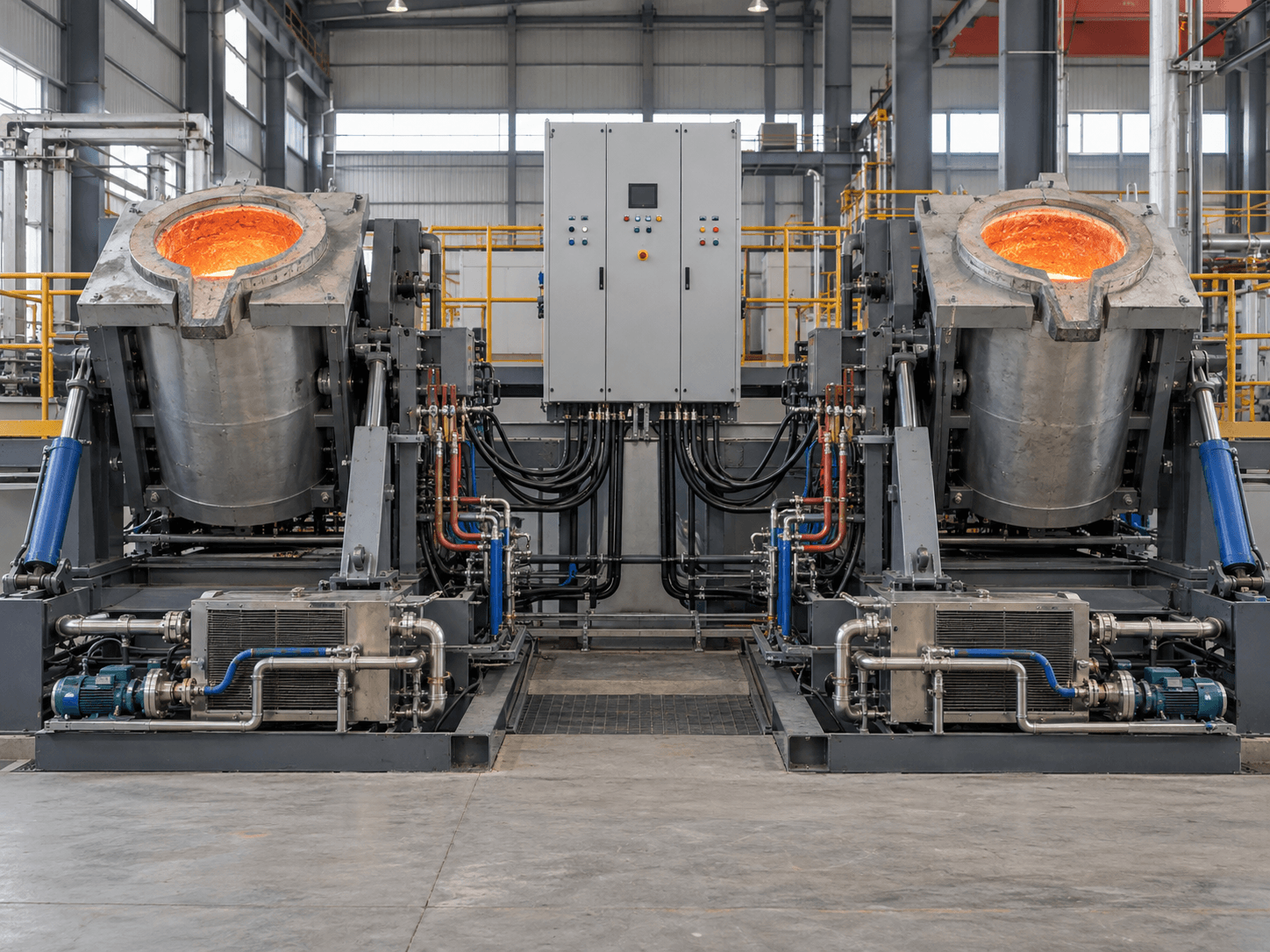
Ask two induction equipment salespeople which power supply to buy and you will get two confident, opposite answers. One will tell you thyristors are obsolete; the other will tell you IGBTs are fragile. Both are selling what they build.
The honest answer is that they suit different duties, and the deciding factors are your grid, your load pattern and how far you are from the nearest service engineer. We build both, so here is the comparison without the sales position.
How they differ, briefly
A KGPS uses thyristors in a parallel-resonance circuit with the capacitor bank across the coil. A thyristor turns on when triggered and turns off when the current naturally crosses zero — simple, robust, and forgiving of an ugly supply.
An IGBT unit switches actively at zero current in a series-resonance circuit. Because the switching is controlled rather than line-commutated, the unit holds a high power factor across the load range and gives far finer control of output.
Where KGPS wins
On a weak grid, on a generator, or on a site with frequent voltage dips, a thyristor unit rides through disturbances that will trip an IGBT unit. Large melting furnaces charged with cold scrap onto a hot heel present exactly the kind of abrupt load swing that KGPS tolerates well.
The other argument is service, and for an export customer it is often decisive. Thyristors, fuses and control components are commodity industrial parts available on most continents, and a competent local electrician can replace one. If your nearest specialist engineer is a flight away, that difference is measured in days of lost production.
- Weak, remote or generator-backed supplies
- Large melting furnaces above roughly 1,000 kW
- Sites where local electrical service must be self-sufficient
- Operations charging cold scrap onto a hot heel
Where IGBT wins
Power factor is the commercial argument. An IGBT unit holds a high power factor from part load to full load, where a thyristor unit's falls away as output is reduced. If your utility bills for reactive power or penalises poor power factor, the difference goes straight onto the electricity bill every month.
Control resolution is the technical argument. Output can be set in 1% steps and held against a temperature or a thermal profile, which is what an induction heating line or a hardening machine needs. A thyristor unit simply cannot hold a scan-hardening recipe to the same tolerance.
- Induction heating, forging and hardening lines
- Sites with reactive-power charges or grid-code obligations
- Small and medium furnaces, and laboratory equipment
- Applications needing recipe or temperature closed-loop control
The cost comparison people get wrong
IGBT units usually carry a higher purchase price and a smaller cabinet; thyristor units are cheaper to buy and cheaper to repair. Comparing purchase price alone misses the two costs that dominate over ten years: electricity, where power factor and efficiency favour IGBT, and downtime, where parts availability favours KGPS.
Work out your own numbers. If your utility does not charge for reactive power and your site is remote, the efficiency advantage may never repay the service disadvantage. If you are on a metered industrial tariff in an urban area with a service engineer nearby, the calculation inverts.
What we recommend, by duty
For a foundry melting above one ton on a normal industrial supply, KGPS remains our default recommendation, and we say so even where the customer arrives asking for IGBT. For heating lines, hardening machines, furnaces below one ton and any application needing closed-loop temperature control, IGBT. For a customer who genuinely cannot get service support locally, KGPS regardless of the other factors.