Cost & Energy
Induction Furnace Power Consumption: What Actually Drives kWh per Ton
Suppliers quote consumption figures under laboratory conditions. Here is what moves the number in a real foundry, and where the savings actually are.
ForgeLink Engineering Team7 min read
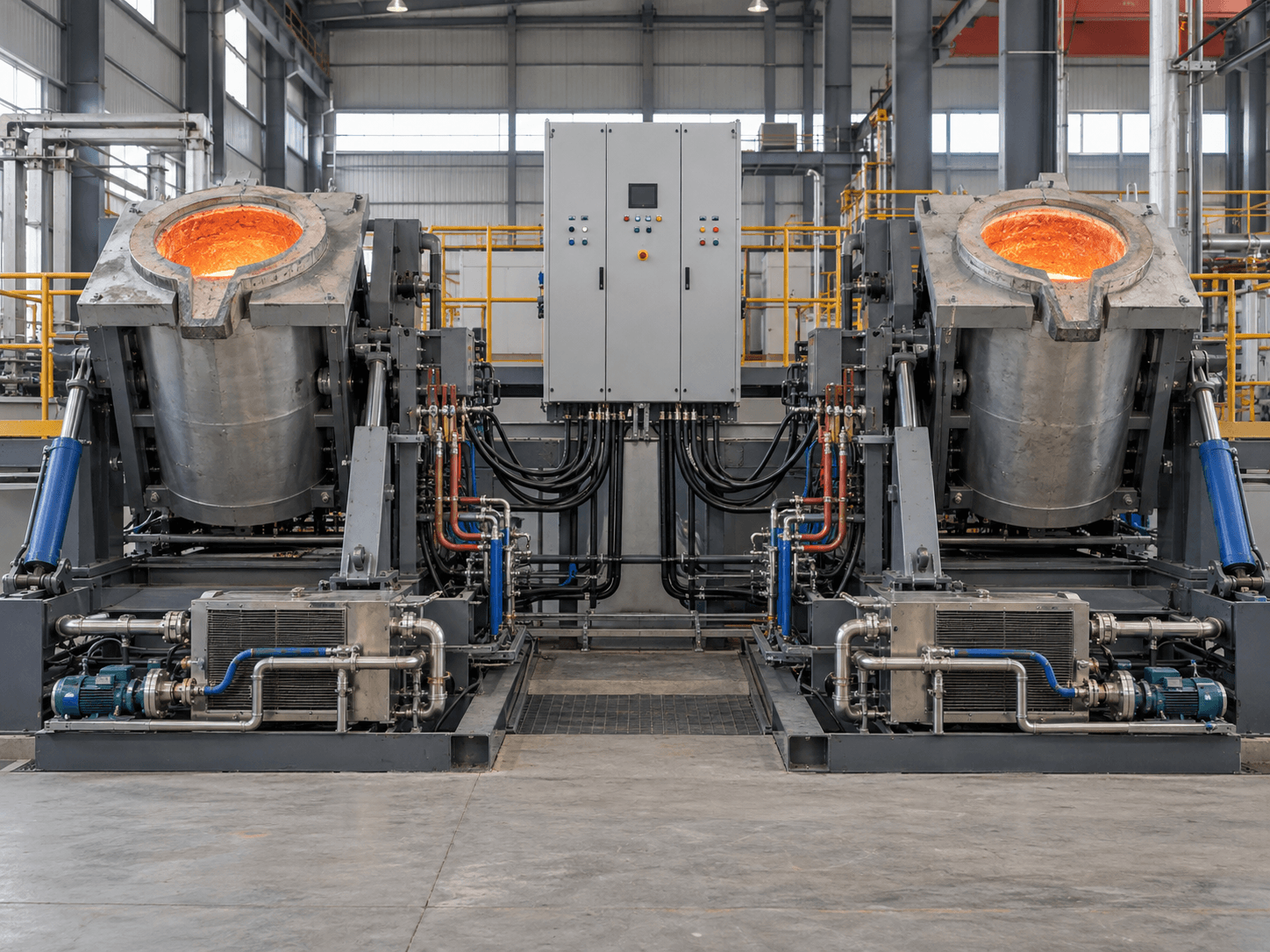
Electricity is typically the largest single cost in an induction melting operation after metal itself, so kWh per ton gets a lot of attention in the buying decision. It deserves rather less than it gets, because the difference between suppliers is usually smaller than the difference between two shifts in the same foundry.
Melting steel from cold to a 1,600 °C tap has a theoretical minimum around 380 kWh per ton. A good modern furnace lands somewhere in the region of 550–620 kWh per ton in practice. Everything between the theory and the practice is loss you have some control over.
Where the energy actually goes
Roughly two thirds of the input energy ends up in the metal as useful heat. The rest is lost in the power supply, in the coil as resistive loss, and through the lining as conducted and radiated heat. Coil and lining losses continue for as long as the furnace is hot, whether or not you are melting.
That last point is the important one, and it is where most avoidable consumption sits: standing losses accumulate with time, not with tonnage. A furnace held full and hot for an hour waiting on a mould has consumed energy with nothing to show for it.
The three things that move the number most
In roughly this order of impact, across the installations we commission.
- Holding time — every hour a full furnace is held hot adds consumption with no output. This is usually the single biggest avoidable item.
- Charge density — light or bulky scrap means more charging cycles, more lid-open time and a longer heat. Compacted or pre-sorted charge measurably reduces kWh per ton.
- Lining condition — a worn lining conducts more heat away and holds more metal per heat, which quietly raises consumption over a campaign.
What the supplier controls
Constant-power tracking matters: the power supply should deliver full rated kW from cold charge through to tap, rather than tapering as coupling changes through the melt. Without it, the last part of the heat runs at reduced power and takes disproportionately longer.
Coil design and lining thickness are the other supplier-side factors. A thicker lining loses less heat but reduces the working volume; a thinner one gives more capacity per furnace footprint and higher standing losses. There is no universally right answer — it depends on whether your operation is melting-heavy or holding-heavy, which is a question the supplier should be asking you.
How to compare quotations honestly
Consumption figures in a quotation are measured under conditions the supplier chooses. Ask three questions before comparing them: what charge material, what tapping temperature, and new lining or mid-campaign? A figure quoted on clean dense scrap with a new lining tapping at 1,550 °C is not comparable with one measured on mixed scrap at 1,650 °C.
Then ask for a reference site with a similar duty and speak to them directly. A foundry running your alloy at your volume will tell you more in ten minutes than any specification sheet.